
Think contractors always fare better in tech layoffs?
That’s a common belief, but it’s only half true.
Contractors escape surprise HR meetings and COBRA shocks, yet they usually miss severance, unemployment benefits, and WARN notice.
Full-time workers get formal safety nets but can face bigger emotional and financial fallout when layoffs hit.
This piece explains what changes in severance, benefits, notice, and taxes, and gives simple steps tech workers should take next.
Quick Verdict on Layoff Differences for Tech Contractors vs Full-Time Employees

Full-time tech employees get laid off with safety nets. Severance packages, unemployment insurance, advance notice under the WARN Act, COBRA health coverage. Contractors? Your engagement agreement ends on schedule or with minimal notice, you don’t qualify for unemployment, and you’ve been managing your own insurance the whole time anyway.
If you’re W-2, you’re looking at a multi-week timeline with final pay, benefits wrap-up, maybe some severance. If you’re 1099, your last invoice is usually your last contact. You pivot to the next client immediately.
But here’s the thing. Contractors often experience less disruption. A three-month contract ending early feels like a normal close-out, not a shock. Employees who’ve been somewhere for years face harder emotional and financial pivots when a layoff hits. Neither path is risk-free. The risk profiles are just completely different.
Severance: Employees may get weeks or months of pay. Contractors get nothing beyond work already invoiced.
Unemployment insurance: Employees can file claims in most states. Contractors typically can’t because they don’t contribute to employer-funded systems.
Advance notice: Employees at large companies may get 60 days under the WARN Act. Contractors get whatever the contract says, often zero.
Health coverage: Employees can elect COBRA for up to 18 months. Contractors manage private plans that don’t change when a gig ends.
Equity and vesting: Employees may lose unvested stock or face tight exercise windows. Contractors rarely hold equity in the first place.
Core Employment Classification Differences Impacting Layoffs

The IRS and Department of Labor classify workers based on control, tools, payment method, and engagement length. Contractors (also called independent contractors, freelancers, or 1099 workers) manage their own taxes, supply their own equipment, set their own schedules within project scope, and invoice clients after work is complete. Full-time employees are W-2 workers whose employers withhold federal and state taxes, provide equipment, set schedules, and deliver regular paychecks with benefits like health insurance, paid time off, and retirement contributions.
Misclassification happens when a company treats a worker as a contractor but exercises employee-level control. Fixed hours, company-issued laptop, direct supervision. If the IRS or state labor authorities reclassify that worker as an employee, the company can owe retroactive payroll taxes, penalties, and back benefits. For tech workers, this matters during layoffs because misclassified “contractors” may suddenly have grounds to claim unemployment or severance they didn’t expect.
| Factor | Contractor (1099) | Full-Time Employee (W-2) |
|---|---|---|
| Tax withholding | Worker pays own quarterly estimated taxes | Employer withholds federal, state, FICA |
| Benefits | Worker purchases own insurance, retirement | Employer provides health, 401(k), PTO |
| Termination rules | Contract end date or early termination clause | At-will or just cause, subject to state law |
| Classification test | Short-term, own tools, invoice pay, independent control | Long-term, company tools, payroll, direct supervision |
Severance Package Differences for Tech Contractors vs Employees

Contractors don’t get severance. When a contract ends early or runs its course, the last invoice gets paid and the relationship closes. Full-time employees at many tech companies receive severance tied to tenure, often one to two weeks of pay per year of service, sometimes more during mass layoffs. During the 2022–2024 tech slowdown, some companies offered four to six months of base pay plus extended healthcare subsidies to soften the landing.
Severance packages for employees can include continued salary, pro-rated bonuses, payout of unused PTO, extended vesting on stock grants, COBRA premium assistance, and access to outplacement services like résumé coaching or job boards. Contractors get none of this. If your contract says “30 days’ notice for early termination,” you might get that notice period paid out. But only if the clause is explicit and enforceable.
Employees laid off in a reduction in force often have room to negotiate severance terms, especially if the company’s offering a standard package. Points to discuss include extended salary payments beyond the standard formula, COBRA subsidies to reduce monthly health premiums, accelerated vesting on unvested stock grants, bonus payout if the layoff happens mid-cycle, PTO payout if company policy doesn’t automatically pay out accrued days, and outplacement support like career coaching, LinkedIn optimization, or interview prep.
Contractors have no such room. The contract is the entire agreement, and any early exit follows the termination clause or happens by mutual consent.
Unemployment Eligibility Differences in Tech Layoffs

Full-time employees who lose their jobs involuntarily (layoffs, position eliminations, company shutdowns) can file for unemployment insurance in most states. Employers fund unemployment systems through payroll taxes. Employees contribute nothing directly. When you’re laid off, you file a claim with your state, verify your work history, and if approved, receive weekly payments for a set period, often 12 to 26 weeks depending on the state and your earnings history.
Contractors can’t claim unemployment in most cases because they don’t participate in employer-funded systems. As 1099 workers, they pay self-employment tax but not into state unemployment pools. A few states have begun experimenting with portable benefits or opt-in unemployment for gig workers, but these programs are rare and narrow. If you’ve been contracting for years and a client suddenly cancels your engagement, you’re on your own financially unless you’ve built an emergency fund or have another contract lined up.
Documentation for employees: Separation notice, last paystub, employer’s federal ID number, and dates of employment. Most states allow online filing and direct deposit of benefits.
State variations: Some states offer extended benefits during recessions or high unemployment. Others cap weekly maximums below what tech salaries would suggest.
What contractors can do instead: Maintain a three to six-month emergency fund, line up backup clients before contracts end, and use freelance marketplaces to find short-term work fast.
Hybrid scenarios: If you worked as a W-2 employee earlier in the year and then switched to contracting, you may be able to claim benefits based on your W-2 quarters. Each state applies different look-back rules though.
WARN Act and Advance Notice Requirements for Tech Roles

The Worker Adjustment and Retraining Notification Act requires employers with 100 or more full-time employees to give 60 days’ written notice before a mass layoff or plant closing. A mass layoff is typically defined as 50 or more employees at a single site within a 30-day period, or one-third of the workforce if that’s larger. The law applies only to W-2 employees, not contractors. If a tech company lays off 200 engineers and 50 of them are contractors, the WARN count is 150. Those 50 contractors get no notice protections.
Employees covered by WARN receive either 60 days to find new work while still employed, or 60 days of pay in lieu of notice if the layoff’s immediate. Some states have “mini-WARN” laws with lower thresholds or longer notice periods. Contractors are excluded from all of these protections because they’re not counted as employees under the statute.
| Worker Type | WARN Coverage | Advance Notice |
|---|---|---|
| Contractor (1099) | Not covered | Contract language only; often zero |
| Employee at WARN-covered company | Covered if mass layoff or plant closing | 60 days or pay in lieu |
| Employee at small company or below threshold | Not covered | At-will; varies by state and company policy |
Health Insurance Continuation, COBRA, and Coverage Loss Timelines

When a full-time employee gets laid off, they can elect COBRA continuation coverage, which allows them to keep the same group health plan for up to 18 months. The employee pays the full premium (employer’s share plus their own share, plus a 2% administrative fee) but the coverage stays active without a gap. COBRA is expensive, often $600 to $1,500 per month for family plans. But it bridges the gap until the worker finds new employer coverage or switches to an Affordable Care Act marketplace plan.
Contractors manage their own health insurance from the start, usually through the ACA marketplace, a spouse’s plan, or a private policy. When a contract ends, nothing changes. There’s no coverage loss, no COBRA election deadline, no scramble to avoid a gap. This independence is an advantage if you’re prepared, but it also means you’re paying full premiums out of pocket every month whether you’re working or not.
Employees have a 60-day window to elect COBRA after termination. If you miss that window, you lose the option. Some severance packages include COBRA subsidies (employer-paid premiums for a few months) to ease the transition. After COBRA runs out or becomes unaffordable, employees can switch to marketplace plans during a special enrollment period triggered by the job loss.
COBRA cost example: If your employer-sponsored plan cost you $200/month in payroll deductions and the employer paid $800, your COBRA premium will be around $1,020/month.
Duration: 18 months for job loss. Up to 36 months if you lose coverage due to divorce, death of the employee, or a dependent aging out.
Marketplace alternative: ACA plans may be cheaper if you qualify for subsidies based on lower post-layoff income.
Contractor reality: You’re already paying full market rates, so a contract ending has no insurance impact.
Gap coverage risk: Employees who delay COBRA election and don’t enroll in marketplace plans face coverage gaps and potential penalties in some states.
Equity, Stock Options, and Vesting Differences at Layoff

Full-time tech employees at startups and public companies often receive stock options, restricted stock units (RSUs), or equity grants as part of total compensation. These grants vest over time, commonly four years with a one-year cliff. If you’re laid off before shares vest, you lose the unvested portion. If you hold vested stock options, you typically have 90 days post-termination to exercise them or they expire. Some companies extend that window to one or two years as part of a severance package, but it’s not guaranteed.
Contractors rarely receive equity. If they do, it’s negotiated separately and structured as a consulting grant with its own terms. Most contractors are paid hourly or project rates with no long-term incentive comp. That means no vesting anxiety during layoffs. Also no upside if the company goes public or gets acquired.
| Equity Element | Employee | Contractor |
|---|---|---|
| Vesting schedule | Typically four years; cliff at one year | Rare; if granted, custom terms |
| Post-termination exercise window | Often 90 days; sometimes extended in severance | N/A unless contract explicitly grants options |
| Refresh grants | Common for retention; lost immediately at layoff | Not applicable |
Employees facing layoffs need to calculate the cost to exercise vested options and decide whether the company’s future upside justifies the cash outlay and tax hit. If the company’s private, illiquid stock can tie up capital for years. If it’s public, you can sell immediately but may face blackout periods or insider trading restrictions if you’re still considered an insider during the notice period.
Rehiring Priority, Recalls, and Access to Internal Opportunities

Some tech companies maintain alumni networks or boomerang hiring programs that give former employees first look at new openings. If you were laid off in good standing, you might get an email six months later inviting you to apply for a new role, sometimes with an expedited interview process. Contractors are almost never included in these programs. Once the contract ends, the relationship’s over unless you proactively reach out to renew or pitch a new project.
Employees also build internal recruiter relationships and peer networks that can lead to referrals at other companies. Managers who valued your work may reach out when they land at a new firm and have headcount. Contractors can build similar networks, but the transactional nature of contract work (short engagements, clear scope, limited integration) makes it harder to cultivate long-term champions.
Recall lists: Some companies create recall or redeployment lists after layoffs, promising to contact former employees before posting roles externally.
Alumni networks: Formal programs with Slack channels, newsletters, and job boards. Contractors are usually excluded.
Referral bonuses: Employees can earn referral fees by recommending laid-off colleagues for open roles at new companies. Contractors rarely have access to these programs.
Internal recruiter access: Former employees often stay in touch with internal talent teams. Contractors typically work with staffing firms or direct hiring managers, not internal TA.
Legal Protections and Contract Terms That Matter During Layoffs

Full-time employees in most U.S. states are employed at-will, meaning either party can end the relationship at any time for any legal reason. Employees can be laid off without cause as long as the reason isn’t discriminatory or retaliatory. Contractors operate under fixed-term or project-based agreements with explicit termination clauses. If your contract says “either party may terminate with 30 days’ written notice,” that’s your only protection. If it says “client may terminate immediately for convenience,” you have none.
Both employees and contractors can face restrictive covenants: noncompete agreements, nonsolicitation clauses, and intellectual property assignment terms. Employees may have signed these as part of an offer letter or employment handbook. Contractors negotiate them in the statement of work or master services agreement. When a layoff happens, these clauses don’t disappear. An employee leaving a company may still be barred from working for a direct competitor for six to twelve months, depending on state enforceability. A contractor finishing a project may be prohibited from soliciting the client’s customers or employees.
| Legal Element | Employee (At-Will) | Contractor (Fixed-Term) |
|---|---|---|
| Termination rule | Can be terminated without cause, subject to discrimination laws | Governed by contract termination clause; may require notice or fee |
| Noncompete enforceability | Varies by state; some states ban or limit duration and geography | Same state law applies; often negotiated more explicitly |
| Post-exit obligations | Return equipment, honor NDA, comply with nonsolicit | Same, plus final invoice and close-out deliverables |
Contractors should review termination language before signing. “Termination for convenience” clauses let clients end contracts early without penalty, while “termination for cause” clauses protect contractors from arbitrary cancellation. Employees have less room to negotiate at-will terms but can sometimes secure severance commitments in offer letters or executive agreements.
Typical Layoff Timelines for Contractors vs Full-Time Employees
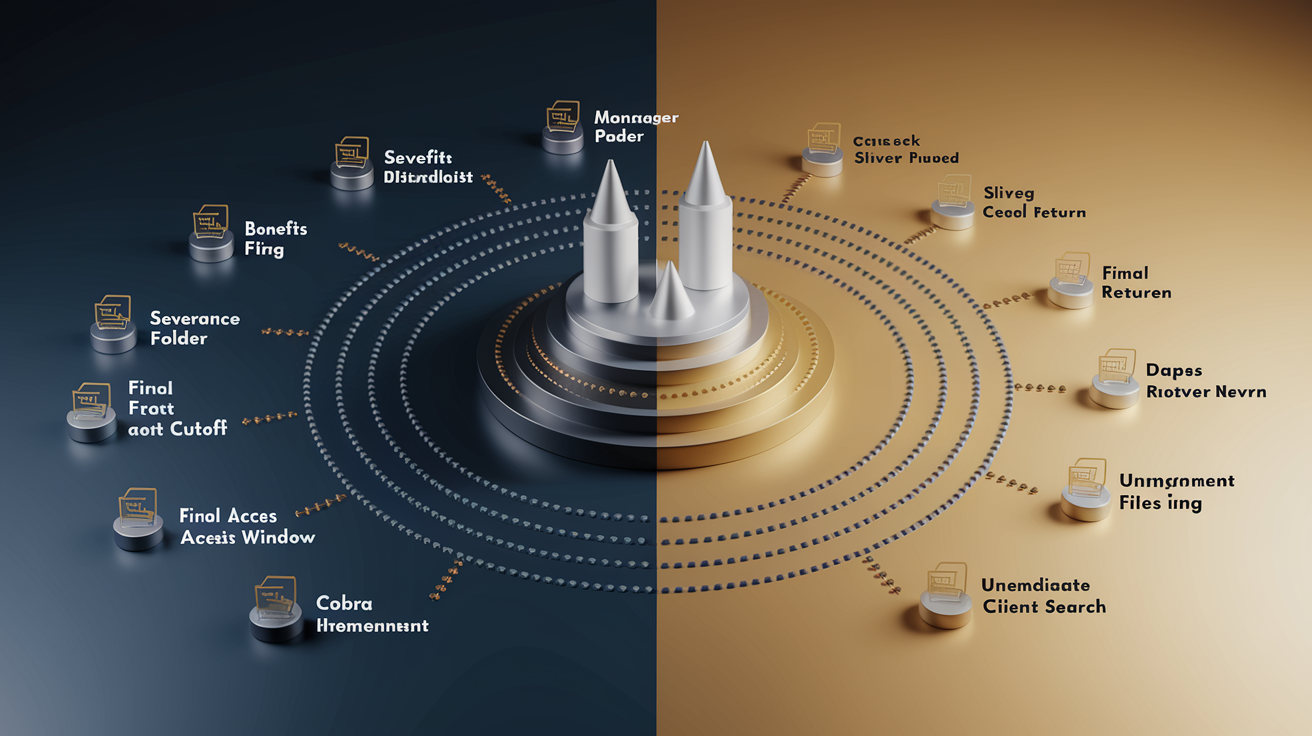
Tech layoffs between 2022 and 2024 followed recognizable patterns. For full-time employees, companies typically announced layoffs in all-hands meetings or email, set an official separation date two to eight weeks out, and provided transition resources: HR contact info, severance paperwork, benefits continuation instructions, and final pay details. Employees lost access to systems on the separation date but often retained email and Slack for a few days to wrap up handoffs.
Contractors experienced faster exits. In many cases, a manager sent a short email or had a brief call saying “We’re ending the contract effective end of this week” or “Your last day is today.” Because contractors aren’t on payroll systems and don’t have benefits to untangle, offboarding is simpler. Submit your final invoice, return the laptop, lose access to systems, and move on.
Full-time employee layoff timeline:
Announcement day: Company-wide communication or department meeting. HR schedules one-on-ones.
Separation date set: Usually 2–8 weeks out. Some companies pay in lieu of work and cut access immediately.
Severance and benefits review: HR provides severance offer, COBRA instructions, equity exercise deadlines, and final pay breakdown.
Final day: Access revoked. Final paycheck and severance start processing.
Benefits continuation window: 60 days to elect COBRA. Equity exercise clock starts.
Unemployment filing: File within a week or two to avoid delays in benefit start date.
Contractor layoff timeline:
Notice (if any): Email or call stating contract end date, often 0–30 days out.
Final work and invoice: Complete outstanding deliverables. Submit last invoice per contract terms.
Payment processing: Invoice paid on standard cycle, often net-30 or net-60.
System access revoked: Usually same-day or within 48 hours.
Next engagement search: Start pitching new clients immediately. No severance or unemployment buffer.
No benefits close-out: Contractor-managed insurance and tax setup continue unchanged.
Choosing Between Contractor and Full-Time Roles Based on Layoff Risk
Full-time roles offer stability through structured layoff protections: severance, unemployment insurance, COBRA, advance notice, and potential equity. If you value predictable income, employer-sponsored benefits, and a formal exit process when things go wrong, a W-2 job fits better. Contractors earn higher hourly or project rates but trade severance and unemployment eligibility for flexibility and faster redeployment. If you can handle income variability and prefer controlling your own schedule and client mix, contracting may be the better risk profile.
Employees face longer, more stressful layoff processes. Waiting weeks between the announcement and your last day, negotiating severance, navigating COBRA enrollment, and exercising stock options all take time and emotional energy. Contractors experience shorter, cleaner breaks. A contract ends, you invoice, you move to the next gig. There’s less drama but also less runway. If you don’t have another client lined up or a robust emergency fund, a sudden contract cancellation can be financially rougher than an employee layoff with a severance cushion.
Best fit for employees: You want employer-paid health insurance, 401(k) match, paid time off, and the safety net of unemployment and severance if a layoff happens. You’re willing to accept at-will risk in exchange for predictable paychecks and benefits.
Best fit for contractors: You value schedule control, project variety, and higher take-home rates. You’re comfortable managing your own taxes, insurance, and retirement. You can handle the risk of sudden contract ends without unemployment backstops.
Hybrid strategy: Some tech workers alternate between contracting and full-time roles, building cash reserves during high-rate contract stints and then taking FTE jobs for benefits and equity upside.
Geographic factors: States with strong unemployment systems and WARN protections tilt the risk-reward toward employees. States with minimal worker protections and high contractor demand tilt it toward contracting.
Industry cycle timing: During hiring booms, contractors command premium rates and can line up back-to-back gigs easily. During downturns, FTE layoffs come with severance. Contractor gigs dry up with no cushion.
How Tech Workers Can Decide the Right Path for Their Situation
The decision between contractor and full-time work hinges on four factors: financial stability, career goals, benefits needs, and project preference. If you have a solid emergency fund, low healthcare costs, and a portfolio of skills that translate across clients, contracting offers speed and earning power. If you need employer-sponsored insurance, want equity upside, or prefer long-term team integration, a full-time role provides structure and safety nets during layoffs.
Before choosing, calculate total compensation for each path. For contractors, add up your hourly rate times expected billable hours, subtract self-employment tax (15.3% on net earnings), and budget for health insurance, retirement contributions, and unbilled time. For employees, include base salary, bonus target, employer 401(k) match, health premium savings, PTO value, and equity grant value. Compare the net take-home and the layoff risk each scenario carries.
If a layoff’s looming or you’re between roles, prepare differently depending on your classification. Contractors should organize contracts, invoices, tax records, and client references so you can pivot to new work within days. Employees should review severance eligibility, equity vesting schedules, COBRA costs, and unemployment filing requirements so you know exactly what to expect when the separation date arrives.
| Decision Factor | Contractor Advantage | Employee Advantage |
|---|---|---|
| Financial stability | High rates, fast pivots, no waiting for severance | Predictable paychecks, severance cushion, unemployment insurance |
| Career goals | Diverse project portfolio, faster skill growth, no promotion wait | Equity upside, long-term team roles, internal mobility and promotions |
| Benefits needs | Healthy, minimal dependents, comfortable buying own insurance | Family health coverage, 401(k) match, paid parental leave, PTO |
| Project preference | Short, varied engagements; boundary control; client diversity | Long-term ownership, deep integration, institutional knowledge building |
Final Words
In the action, here’s the quick take: full-time tech employees generally get stronger protections at layoff — severance, unemployment eligibility, COBRA for health coverage, and notice under laws like WARN when it applies. That gives more runway to find the next role.
Contractors usually don’t get those safety nets but often face less disruption because they can pick up new gigs faster. When weighing contractor vs full-time layoffs differences for tech workers, balance protection against flexibility, shore up savings, and keep networking — you’ll be ready either way.
FAQ
Q: Is it better to be a contractor or full-time employee?
A: The choice between being a contractor or full-time employee depends on your priorities: contractors get higher pay and flexibility but no benefits or severance; full-time offers health coverage, unemployment eligibility, WARN notice, and stability.
Q: Will tech layoffs get worse?
A: The prospect of tech layoffs getting worse is uncertain; hiring follows market cycles. Watch company cash, hiring freezes, and role demand—build emergency savings and update skills to cut personal risk.
Q: What is the 3 month rule for jobs?
A: The 3 month rule for jobs means staying about three months to pass probation, show value, and avoid resume red flags; it also affects benefits eligibility and signals reliability to future employers.
Q: What are the 3 C’s of contractor management?
A: The 3 C’s of contractor management are clear scope, continuous communication, and compliance—define deliverables, set regular check-ins, and enforce contract, tax, and IP rules to reduce disputes and delays.
Leave a Reply