
What if your supply chain could know what customers will buy next week and update that answer every few hours?
AI is doing exactly that by crunching sales history, promotions, weather, social chatter, and live inventory into models that learn on the job.
Instead of one static forecast, AI produces SKU (product code) and store-level predictions plus ranges that show how certain the model is.
The result: fewer stockouts, less waste, and smarter ordering that matches real customer needs.
This post explains which models and data sources drive those gains and what to do first.
Core Ways AI Enhances Supply Chain Demand Forecasting Accuracy

AI changes supply chain demand forecasting by chewing through massive datasets and spotting patterns that older methods just can’t see. Machine learning algorithms look at historical sales, promotions, pricing, weather, social sentiment, all at once. They adjust predictions as fresh data comes in. Deep learning models like LSTMs and Transformers pick up on complex seasonal rhythms and long-range dependencies across thousands of SKUs. Natural language processing pulls demand signals from customer reviews, news headlines, social feeds. IoT sensors and RFID tags pump real-time inventory and shipment data straight into models, so demand sensing updates forecasts hourly instead of weekly. “Before AI, our replenishment plans were weeks old by the time they reached stores. Now we adjust them daily based on live shelf data.”
Accuracy improvements? You can measure them. AI-driven forecasts typically cut mean absolute percentage error by 10 to 50 percent compared to statistical baselines like ARIMA or exponential smoothing. That means 10 to 30 percent lower inventory on hand while you’re maintaining or improving service levels. Stockout reductions of 5 to 20 percent. Traditional methods struggle with non-linear interactions. Promotion lift during holidays, weather-driven spikes, sudden shifts in consumer sentiment. They rely on fixed coefficients and linear assumptions. AI handles these dynamics by continuously retraining on fresh data, adjusting weights, learning from forecast errors.
Probabilistic forecasting adds another layer. Instead of a single number, AI models output prediction intervals: 90th percentile, 50th percentile, 10th percentile. Planners see the range of likely outcomes and set safety stock accordingly. This uncertainty quantification matters for managing tail risk, especially with perishable goods or fashion items that have short selling windows.
Six concrete examples of AI-powered forecasting actions at SKU and location level:
- SKU-store daily replenishment: AI predicts tomorrow’s sales for every SKU in every store, auto-generating purchase orders for distribution centers.
- Promotion lift estimation: Models forecast demand spikes for a specific SKU during a markdown event, preventing both stockouts and excess.
- New-product ramp forecasting: Transfer learning from similar SKUs predicts initial demand curves for launches with no sales history.
- Perishables waste reduction: Sub-daily forecasts adjust orders for fresh produce based on weather and local events, cutting spoilage.
- Seasonal safety-stock tuning: Probabilistic models recalculate buffer inventory weekly as lead times and demand volatility shift.
- Markdown timing optimization: AI forecasts residual demand for aging inventory, recommending when to discount to clear stock profitably.
Key AI Models Used for Supply Chain Demand Forecasting

Demand forecasting pulls from several model families, each suited to different data structures and business needs. Practitioners often deploy ensembles that combine statistical baselines with machine learning and deep learning components for robustness.
LSTM & GRU Sequence Models
Long Short-Term Memory networks, introduced in 1997, are still widely used for time-series forecasting. LSTMs maintain a memory cell that captures long-range dependencies. Useful for modeling trends that span months or years. Gated Recurrent Units (GRUs) offer a simpler, faster variant. Both architectures excel at capturing weekly and seasonal patterns in historical sales data. Retailers use LSTM-based models to forecast SKU demand across hundreds of stores, feeding in lagged sales, day-of-week indicators, promotional flags. Training requires sufficient historical depth. Typically two to three years of daily or weekly data. GPUs accelerate convergence on large SKU catalogs.
Transformer-Based Architectures
Transformers, first published in 2017 for natural language tasks, have been adapted for multivariate time series. The Temporal Fusion Transformer combines attention mechanisms with variable selection, learning which features matter most at each forecast horizon. Transformers handle long sequences efficiently and can process external regressors: weather, holidays, competitor prices, alongside sales history. They shine in scenarios with complex cross-SKU interactions, such as product cannibalization or category-level promotions. Training costs are higher than tree-based models, but inference is fast enough for daily batch forecasting at enterprise scale.
Gradient-Boosted Tree Models
XGBoost and LightGBM dominate tabular demand-forecasting competitions and production systems. These models build ensembles of decision trees, iteratively correcting errors. They require less data preprocessing than neural networks, handle missing values gracefully, train quickly on CPUs. Feature engineering is critical: lagged sales, rolling averages, promotion indicators, price elasticity proxies, holiday flags. Boosted trees often serve as the baseline best-in-class model. Many teams blend them with neural networks in stacked ensembles for marginal accuracy gains.
Probabilistic and Ensemble Approaches
Quantile regression and pinball loss functions let models predict the 10th, 50th, and 90th percentiles of demand instead of a single point estimate. Essential for inventory optimization, where planners need to know the range of likely outcomes to set safety stock and service levels. Ensembles combine outputs from ARIMA, exponential smoothing, XGBoost, and LSTM, weighting each model by historical performance. Hybrid approaches are common in production: a statistical model handles baseline demand, an XGBoost model captures promotion effects, an LSTM adjusts for trend shifts, with final forecasts blended via weighted averaging.
| Model Type | Primary Use | Strengths |
|---|---|---|
| LSTM / GRU | Seasonal and trend capture | Long-range memory, handles weekly/monthly cycles |
| Transformers | Multivariate, long-horizon forecasts | Attention on key features, cross-SKU interactions |
| XGBoost / LightGBM | Tabular demand data, promotions | Fast training, handles missing data, strong baseline |
| Probabilistic Ensembles | Uncertainty quantification, safety stock | Prediction intervals, robust to model drift |
Data Sources and Feature Engineering for AI Demand Forecasting

Accurate AI forecasting starts with clean, comprehensive data pipelines. Internal sources include point-of-sale transactions, ERP systems (order history, lead times, supplier performance), warehouse management systems (inventory snapshots, putaway/pick data), CRM platforms (customer segments, loyalty program activity). SKU master data (category, brand, pack size, shelf life) helps models learn cross-product patterns. Promotion calendars, pricing changes, markdown schedules are critical features. Without them, models treat organic demand and promotion-driven spikes identically, inflating error.
External signals dramatically improve responsiveness. Weather data (daily temperature, precipitation, humidity) drives demand for beverages, apparel, home goods. Macroeconomic indicators like unemployment rates, consumer confidence indices, fuel prices capture broader market shifts. Social media sentiment and Google Trends volumes flag emerging trends or viral moments. Event calendars (holidays, sports championships, concerts) explain localized demand surges. IoT feeds from connected devices, RFID tags on pallets, GPS trackers on delivery trucks provide real-time context. A delayed shipment can trigger an automatic forecast adjustment for the destination store.
Seven common feature types fed into AI demand models:
- Lagged sales (prior 7, 14, 28, 365 days)
- Rolling averages and exponential smoothing values
- Promotion flags (on/off, discount depth, promotion type)
- Price and price elasticity proxies (current price, price change %)
- Seasonality indicators (day of week, week of year, holidays)
- External regressors (weather, economic indices, competitor actions)
- SKU and location attributes (category, region, store format)
| Data Source | Benefit to Forecasting |
|---|---|
| Point-of-Sale (POS) | Ground truth for daily SKU-store demand; captures real consumer purchase behavior |
| Weather APIs | Adjusts forecasts for temperature-driven spikes (ice cream, winter apparel) and precipitation effects |
| IoT / RFID / GPS | Real-time inventory visibility and shipment tracking enable sub-daily forecast updates and stock-out prevention |
Real-World Applications of AI in Forecasting Across Industries

Retailers deploy AI forecasting to rationalize SKU assortments and optimize shelf space. A European supermarket chain used demand-sensing models fed by POS data, promotional calendars, local event schedules to cut slow-moving SKUs and expand high-turnover items, generating a €30 million increase in profit margins. The system combined gradient-boosted trees for baseline demand and LSTM networks for seasonal adjustments, retraining weekly on fresh sales data. Forecast accuracy improved by 22 percent. Stockouts on popular items dropped by 15 percent.
Manufacturers in fast-moving consumer goods (FMCG) apply AI to promotion planning and multi-echelon inventory optimization. A beverage company integrated weather forecasts, social media sentiment, retailer POS feeds into a Temporal Fusion Transformer model. The system predicted promotion lift within 8 percent mean absolute error, enabling the firm to pre-position inventory at regional distribution centers and reduce expedited shipping costs by 18 percent. The model outputs probabilistic forecasts, so planners set safety stock at the 90th percentile for high-margin SKUs and the 70th percentile for lower-margin products.
Food and perishables supply chains rely on sub-daily sensing to minimize waste. A fresh-produce distributor used IoT temperature sensors, real-time traffic data, hourly weather updates alongside historical sales patterns in an ensemble model. Predictions updated every six hours, adjusting delivery quantities to restaurants and grocery stores. Spoilage fell by 12 percent. On-time-in-full delivery rates rose by 9 percent. The distributor credited the system’s ability to react to sudden weather changes. A rainstorm canceling outdoor events meant fewer salad orders at nearby cafés.
Five industry cases with data, model type, and measurable impact:
- Fashion retail: Combined clickstream data, social media trends, historical sales in an XGBoost model; reduced markdown waste by 20% and improved sell-through rates by 14%.
- Pharmaceuticals: Used ERP, distributor shipment logs, disease-outbreak alerts in a hybrid statistical + LSTM model; cut stockouts of critical medications by 25% and improved service levels to hospitals.
- Building materials: Integrated construction-permit data, weather forecasts, distributor inventory into a GRU network; lowered safety stock by 18% while maintaining 98% fill rates.
- E-commerce: Applied transformer models to clickstream, search trends, past purchase patterns; achieved 30% reduction in last-mile delivery delays by pre-positioning inventory at fulfillment centers.
- Automotive aftermarket: Combined telematics data (vehicle age, mileage) and warranty claims in an ensemble model; improved spare-parts availability by 22% and reduced expedited freight spend by $4.2 million annually.
How AI Systems Operate Inside Modern Demand Forecasting Workflows

AI forecast engines follow a structured pipeline from raw data ingestion to actionable planner dashboards. Data ingestion pulls sales transactions, inventory snapshots, promotional schedules, external signals (weather, economic indicators, social media metrics) into a central data lake or warehouse. Cleaning and validation steps handle missing values, outliers, schema mismatches. Imputation fills gaps in POS data from store outages. Anomaly detection flags unusual spikes that might indicate data errors rather than true demand shifts.
Feature engineering transforms raw inputs into model-ready signals: lagged sales, rolling averages, promotion flags, seasonality indicators, price-change deltas, external regressors. Model training runs on historical windows, often using rolling-origin cross-validation to simulate real deployment conditions. Validation compares point forecasts and prediction intervals against holdout data, measuring MAPE, MAE, pinball loss. Once validated, models deploy into production, generating forecasts on a daily or hourly schedule. Continuous learning pipelines retrain models weekly or monthly as new sales data arrives, detecting and correcting for model drift. Forecasts feed into planner dashboards, ERP replenishment modules, warehouse management systems via APIs, closing the loop from prediction to action. “Our system pushes tomorrow’s SKU-level forecasts directly into our auto-replenishment engine every night, so store orders generate without manual intervention.”
Ordered workflow steps:
- Ingest data from POS, ERP, WMS, CRM, weather APIs, IoT sensors into a unified data platform.
- Clean and validate transactions, handling missing values, duplicates, schema inconsistencies.
- Engineer features including lags, rolling statistics, promotion indicators, seasonality, external regressors.
- Train models using historical windows and cross-validation; tune hyperparameters on validation folds.
- Backtest forecasts against holdout periods to estimate real-world accuracy and calibration.
- Deploy to production on a scheduled batch or streaming pipeline, generating forecasts at required granularity (SKU-store-day).
- Monitor performance via automated drift detection, tracking error metrics and flagging degradation.
- Retrain periodically (weekly, biweekly, or monthly) to incorporate fresh data and adapt to market shifts.
| Workflow Stage | Typical Tools | Data Refresh Frequency |
|---|---|---|
| Ingest & Clean | Apache Kafka, AWS Glue, Talend, dbt | Daily or hourly batch; streaming for real-time signals |
| Model Training | Python (scikit-learn, XGBoost, PyTorch), cloud ML platforms (SageMaker, Vertex AI) | Weekly or monthly retraining cadence |
| Forecast Delivery | REST APIs, ERP connectors, BI dashboards (Tableau, Power BI) | Daily forecasts pushed to planners and systems; sub-daily for perishables and e-commerce |
Benefits of Using AI for Supply Chain Forecasting and Inventory Optimization

AI forecasting delivers measurable improvements across inventory, service levels, operating costs. Forecast accuracy gains of 10 to 50 percent translate directly into lower safety stock. Companies report inventory reductions of 10 to 30 percent while maintaining or improving fill rates. Fewer stockouts mean happier customers and fewer lost sales. Typical service-level improvements range from 5 to 20 percent. Because forecasts update more frequently and incorporate real-time signals, planners can shorten replenishment cycles and respond faster to demand shifts, reducing reliance on expedited shipping and rush orders.
Automated replenishment systems use AI forecasts to generate purchase orders without manual review, freeing planners to focus on exceptions and strategic decisions. Probabilistic forecasts support dynamic safety-stock policies: high-margin SKUs get buffered at the 90th percentile, low-margin items at the 70th, optimizing working capital. Multi-echelon optimization links forecasts at store, distribution center, supplier levels, ensuring the right inventory sits at the right node. This coordination cuts lead-time variability and reduces bullwhip effects, where small demand fluctuations amplify upstream.
Financial benefits include lower carrying costs (warehouse space, insurance, obsolescence) and improved cash flow from reduced on-hand inventory. Planners also gain visibility into demand volatility and can run scenario analyses. What happens if a promotion underperforms, or a competitor launches a rival product? Strengthening resilience against surprises.
Seven quantifiable benefits of AI-driven demand forecasting:
- 10–50% reduction in mean absolute percentage error (MAPE) vs. traditional statistical methods.
- 10–30% lower inventory levels while maintaining target service levels.
- 5–20% improvement in fill rates and on-shelf availability, reducing stockouts.
- Faster replenishment cycles, shortening lead times from weeks to days or hours for high-velocity SKUs.
- Automated order generation, cutting planner workload by 30–60% and reducing manual errors.
- Dynamic safety-stock optimization, freeing working capital and lowering carrying costs by 15–25%.
- Reduced expedited shipping and rush orders, saving 10–20% on logistics and freight spend.
Challenges, Risks, and Limitations of AI-Based Demand Forecasting

Data quality and siloing remain the biggest barriers. Incomplete POS feeds, inconsistent SKU identifiers across systems, missing promotional flags degrade model accuracy. Companies often discover that ERP, WMS, CRM systems use different product codes or timestamp formats, requiring costly ETL work to harmonize. Poor data hygiene (duplicate records, uncorrected errors, stale master data) propagates through the pipeline. Models trained on flawed inputs produce unreliable forecasts.
Model drift is a persistent risk. Consumer behavior shifts. Competitors launch new products. Suppliers change lead times. Macroeconomic conditions evolve. A model trained on pre-pandemic data failed spectacularly during lockdowns. Many firms had to retrain from scratch. Continuous monitoring and retraining mitigate drift, but teams must balance retraining frequency against compute costs and the risk of overfitting to short-term noise. Explainability is another challenge: deep learning models are black boxes. Stakeholders hesitate to trust forecasts they can’t interpret. SHAP values and feature-importance plots help, but non-technical planners still prefer simpler, more transparent models when possible.
Cold-start problems plague new SKUs, store openings, product launches. Without historical sales data, models default to category averages or transfer learning from similar items, but accuracy suffers until enough data accumulates. Hierarchical models and attribute-based clustering (grouping SKUs by brand, size, price tier) offer partial solutions. Organizational resistance slows adoption. Planners accustomed to spreadsheet-based forecasting fear job displacement or distrust AI recommendations. Change management (training, pilot projects, demonstrating ROI) is critical. Data privacy and security loom large when integrating third-party signals like social media or competitor pricing. Firms must audit data sources, enforce access controls, comply with regulations like GDPR.
Five common technical and organizational risks:
- Data silos and integration complexity: harmonizing ERP, WMS, POS, external feeds requires significant engineering effort and ongoing maintenance.
- Model drift and performance degradation: market shifts invalidate trained models; continuous monitoring and retraining are essential.
- Explainability gaps: stakeholders demand interpretable forecasts; black-box models face resistance without transparency tools like SHAP or simpler ensemble components.
- Cold-start for new SKUs and launches: lack of historical data forces reliance on clustering or transfer learning, reducing initial accuracy.
- Change management and organizational buy-in: planners and executives need training, proof-of-concept wins, clear ROI to trust and adopt AI-driven workflows.
Implementation Roadmap for Deploying AI Forecasting in Supply Chains
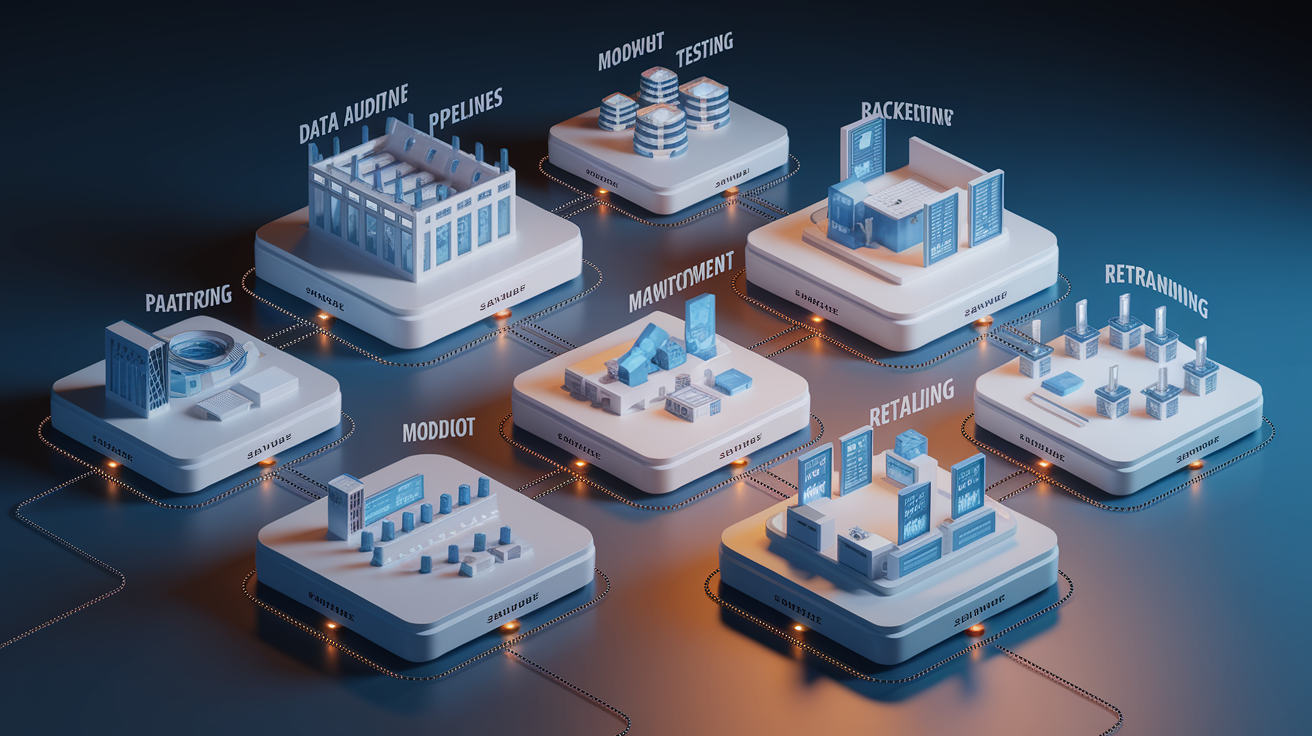
Rolling out AI demand forecasting requires a phased approach that balances quick wins with sustainable infrastructure. Start with a data audit: assess completeness, refresh frequency, coverage of sales, inventory, promotions, external signals. Identify gaps. Missing POS feeds from certain stores, incomplete promotional calendars, lack of weather or economic data. Prioritize fixes. Build or buy ETL pipelines to ingest, clean, harmonize data into a central repository. Establish data governance: define SKU master records, enforce consistent timestamps, automate anomaly detection to flag bad data before it reaches models.
Select a pilot scope. High-variability SKUs, a single product category, a few stores to prove value quickly. Feature engineering begins here: create lagged sales, rolling averages, promotion flags, seasonality indicators, external regressors. Train baseline models (ARIMA, exponential smoothing) and compare against machine learning candidates (XGBoost, LSTM, ensemble methods). Backtest using rolling-origin cross-validation, measuring MAPE, MAE, probabilistic metrics like pinball loss. Validate that prediction intervals are well-calibrated: the 80th percentile forecast should cover actual outcomes roughly 80 percent of the time.
Deploy the winning model into production on a daily batch schedule. Integrate forecast outputs with ERP, WMS, S&OP workflows via APIs or file exports. Set up dashboards for planners, showing SKU-level forecasts, confidence intervals, alerts for unusual predictions. Monitor performance continuously: track forecast error, detect drift, compare live results against backtests. Retrain models on a fixed cadence (weekly, biweekly, or monthly) and trigger emergency retraining if error spikes. Gradually expand scope: add more SKUs, categories, stores, refining features and tuning models as you scale. Embed human-in-the-loop review for high-stakes decisions (new product launches, major promotions) until confidence builds. Link forecasts into broader S&OP and collaborative planning processes, ensuring alignment between sales, operations, finance on demand expectations and inventory targets.
Implementation roadmap steps:
- Conduct a data audit: map available sources (POS, ERP, WMS, CRM, external APIs), assess quality, identify gaps.
- Build data pipelines: ingest, clean, validate, harmonize sales, inventory, promotions, external signals into a unified platform.
- Define pilot scope: select high-variability SKUs, a category, or a region to demonstrate ROI quickly.
- Engineer features: create lagged sales, rolling stats, promotion flags, seasonality, price changes, external regressors.
- Train and backtest models: compare statistical baselines, ML, deep learning; validate on holdout periods using MAPE, MAE, pinball loss.
- Deploy to production: schedule daily or hourly batch runs; integrate outputs into ERP, WMS, planner dashboards via APIs.
- Monitor and retrain: track forecast error, detect drift, retrain weekly or monthly, trigger ad-hoc retraining when performance degrades.
- Scale and integrate: expand to more SKUs and locations; embed forecasts into S&OP, replenishment automation, collaborative planning workflows.
| Implementation Stage | Key Activities | Expected Output | Typical Timeline |
|---|---|---|---|
| Pilot / Proof-of-Concept | Data audit, feature engineering, model training, backtesting on a category or region | Validated model, accuracy benchmarks, initial ROI estimate | 8–12 weeks |
| Production Deployment | API integration, dashboard build, daily batch scheduling, initial monitoring setup | Live forecasts feeding ERP/WMS, planner dashboards, automated alerts | 4–8 weeks post-pilot |
| Scaling & Optimization | Expand SKU/location coverage, refine features, tune retraining cadence, embed into S&OP | Enterprise-wide forecast coverage, continuous improvement loop, measurable inventory and service-level gains | 6–12 months |
| Continuous Operations | Ongoing monitoring, drift detection, monthly retraining, stakeholder training, process refinement | Sustained forecast accuracy, alignment with business KPIs, organizational adoption | Ongoing |
Essential Considerations When Using AI for Supply Chain Demand Forecasting

Successful AI forecasting projects share common practices. Prioritize data hygiene over model complexity. A simple XGBoost model trained on clean, complete data will outperform a sophisticated Transformer fed garbage. Start pilots on high-variability SKUs or categories where traditional methods fail. Early wins build momentum and stakeholder trust. Design for uncertainty: probabilistic forecasts and prediction intervals matter more than chasing the lowest point-error metric, because inventory decisions depend on understanding the range of possible outcomes, not just the mean.
Build resilience through scenario planning. Run simulations for demand shocks. What if a key supplier delays shipments by two weeks, or a competitor launches a price war? Stress-test how forecasts and inventory policies respond. Invest in continuous learning infrastructure: automated retraining, drift detection, performance dashboards ensure models stay relevant as markets shift. AI forecasting is a tool, not a strategy. The best systems combine algorithmic precision with human judgment. Planners review and override forecasts when they spot context the model missed, and the feedback loop improves future predictions.
Six concise reminders for AI forecasting projects:
- Clean data beats fancy models. Prioritize data quality, completeness, integration before tuning hyperparameters.
- Start with high-variability SKUs or categories to demonstrate measurable impact quickly.
- Use probabilistic forecasts and prediction intervals to inform safety-stock and service-level decisions.
- Plan for continuous retraining and drift monitoring; market conditions change, and models must adapt.
- Run scenario analyses and stress tests to build supply chain resilience against shocks.
- Keep humans in the loop. Planner overrides and feedback improve model performance and organizational buy-in.
Final Words
AI now combines machine learning, deep learning, NLP and IoT to boost forecast accuracy, cut inventory, and enable near-real-time demand sensing. It pulls POS, ERP, weather and promotion data to catch patterns traditional methods miss.
Practical steps are clear: clean your data, pick the right models, backtest, and add continuous retraining with planner review.
On how AI is used in supply chain demand forecasting: start with high-variability SKUs, measure gains, and scale. The result is fewer stockouts and lower costs—so it’s worth trying.
FAQ
Q: How is AI used to improve supply chain demand forecasting accuracy?
A: AI is used to improve supply chain demand forecasting accuracy by combining machine learning, deep learning, NLP, IoT and predictive analytics to handle complex drivers, boost accuracy 10–50%, and enable near real‑time demand sensing.
Q: What AI models are commonly used for demand forecasting?
A: Common AI models for demand forecasting are LSTM and GRU sequence models, transformer-based time series architectures, gradient-boosted trees, and probabilistic/ensemble approaches that balance accuracy, interpretability, and robustness.
Q: What data sources are needed for AI demand forecasting?
A: Data sources needed for AI demand forecasting include point‑of‑sale, ERP/WMS, CRM, SKU masters, promotions, pricing, supplier lead times, weather, social sentiment, and IoT sensor feeds, all cleaned and pipelined for reliability.
Q: Can AI forecast at SKU and store level and what are examples?
A: AI can forecast at SKU and store level by performing SKU-level demand sensing, promotion lift per store, optimized replenishment timing, shelf-level allocation, SKU rationalization, and sub‑daily ordering for perishables.
Q: What business benefits and metrics improve with AI forecasting?
A: Business benefits and metrics improved by AI forecasting include 10–30% lower inventory, 5–20% higher service levels, 10–50% better forecast accuracy, fewer stockouts, lower expedited shipping, and improved inventory turnover.
Q: What are common challenges of AI forecasting and how are they mitigated?
A: Common challenges of AI forecasting are poor data quality, siloed systems, model drift, explainability needs, and cold starts; mitigations include strong ETL pipelines, retraining, explainable models like SHAP, transfer learning, and stakeholder training.
Q: How long does implementation take, how much does it cost, and when is ROI seen?
A: Typical implementation timelines and costs are 8–12 week POCs, full deployments ranging $100K–$1M, with typical ROI observed within 6–18 months depending on scope and data readiness.
Q: How do AI forecasting systems operate inside modern workflows?
A: AI forecasting systems operate by ingesting and cleaning data, engineering features, training and validating models, deploying and monitoring continuously, then delivering forecasts to planners via APIs and dashboards for near real‑time updates.
Q: How often should forecasting models be retrained and monitored?
A: Models should be retrained and monitored regularly: retrain weekly to monthly for high‑volatility items, quarterly for stable SKUs, continuously monitor drift and backtest, and keep human planners in the loop for overrides.
Q: What should companies consider before deploying AI forecasting?
A: Companies should consider before deploying AI forecasting to ensure data hygiene, start with high‑variance SKUs, define KPIs and S&OP integration, plan change management, allocate MLOps resources, and run realistic backtests.
Leave a Reply